



Description
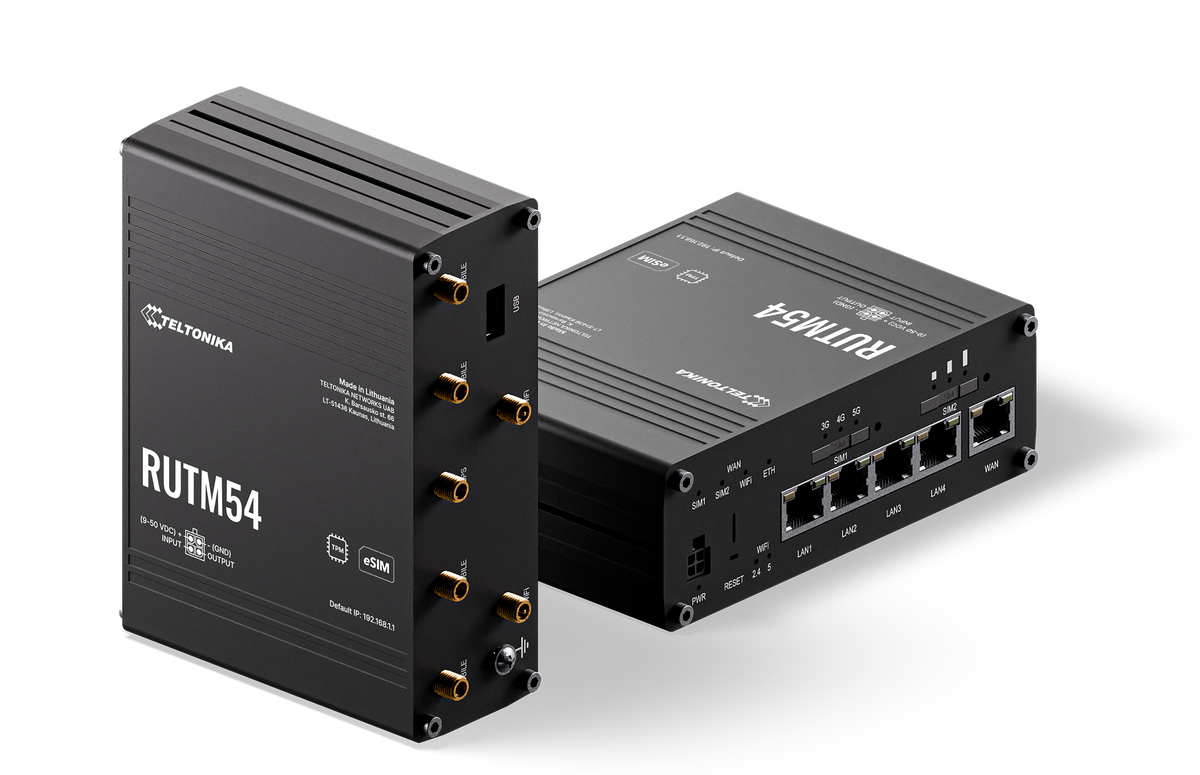
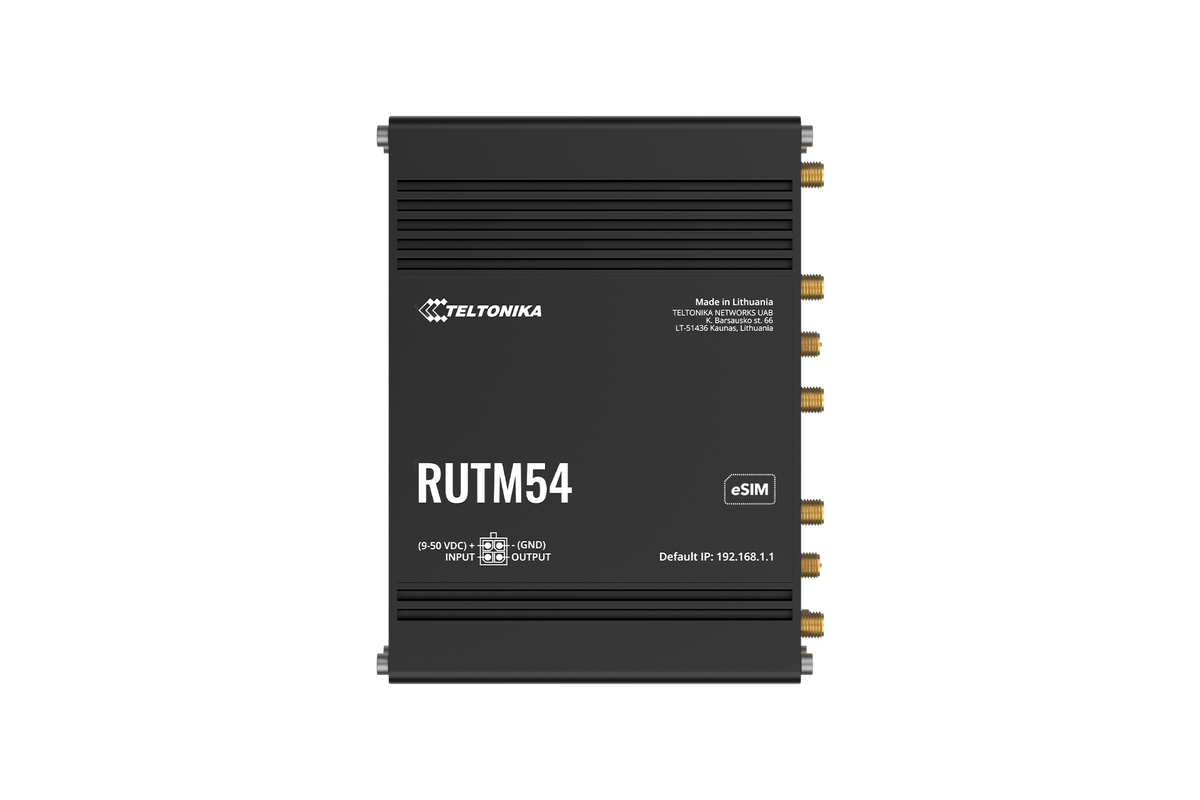
The Teltonika RUTM54 (RUTM54000000) is a high-performance 5G router for data-heavy business and industrial sites that need dependable uplink and carrier flexibility. A US-made Telit 5G modem, dual SIM plus eSIM, five Gigabit Ethernet ports, dual-band Wi-Fi, and automatic failover keep traffic moving even when one connection drops.
It supports both SA and NSA 5G with 4G fallback, and its High Power User Equipment (HPUE) mode boosts transmit power on select bands for a stronger uplink at the edge of coverage.
The Telecom Spot Take
Choose the RUTM54 when modem origin, eSIM, and uplink strength matter. The US-made Telit module suits projects with sourcing requirements, eSIM lets you change carriers remotely, and HPUE on LTE B41 and 5G n41, n77, and n78 helps fringe-coverage sites push more upstream data, such as video uploads. It is rated to +75°C, higher than the RUTM50. For very tight spaces, the compact RUTM20 fits better.
Key Features
- US-made Telit 5G modem: A Telit module made in the U.S., helpful for organizations with hardware sourcing policies.
- Dual SIM plus eSIM: Automatic failover, backup WAN, and remote carrier switching through eSIM, without a site visit to swap cards.
- HPUE for stronger uplink: 27 dBm max transmit power on LTE B41 and 5G n41, n77, and n78, compared with 24 dBm on other LTE and 5G bands, for better upload performance far from the tower.
- 5G SA and NSA with 4G fallback: Works with both 5G architectures and drops to 4G or 3G where 5G is not available.
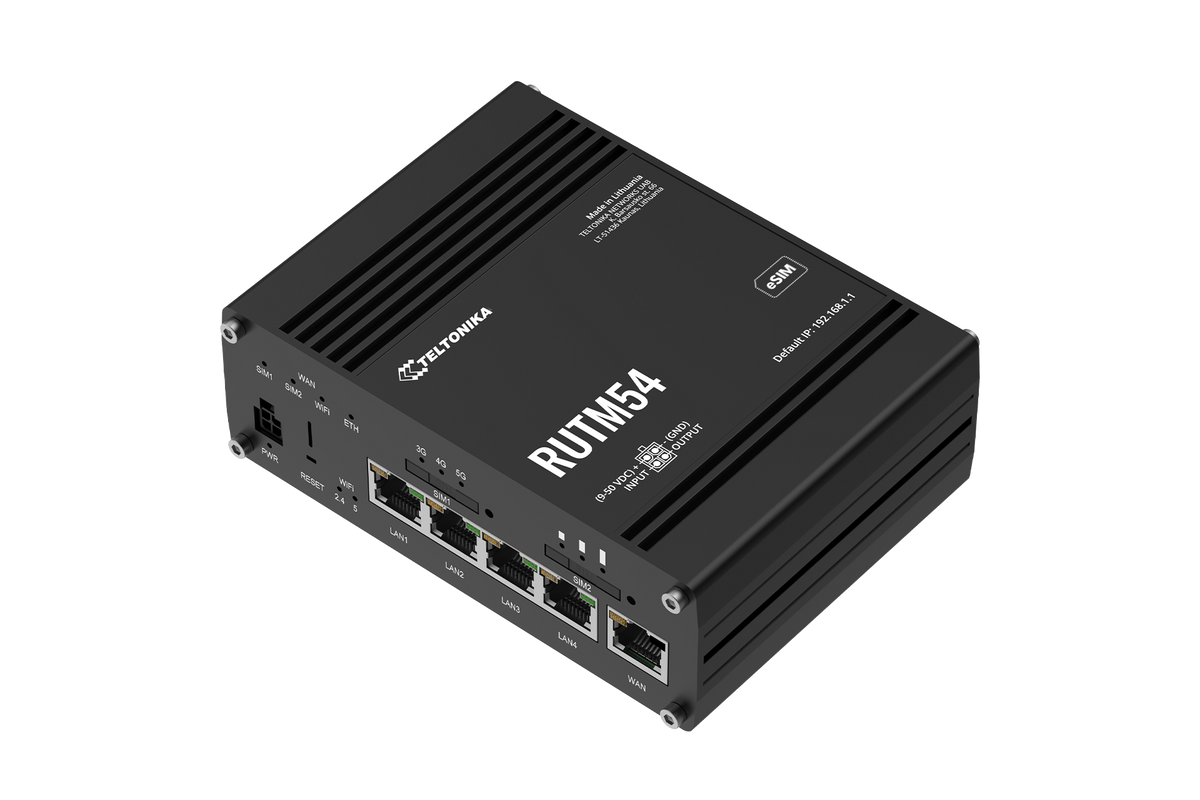
- Five Gigabit Ethernet ports: Run a small office or equipment rack directly from the router.
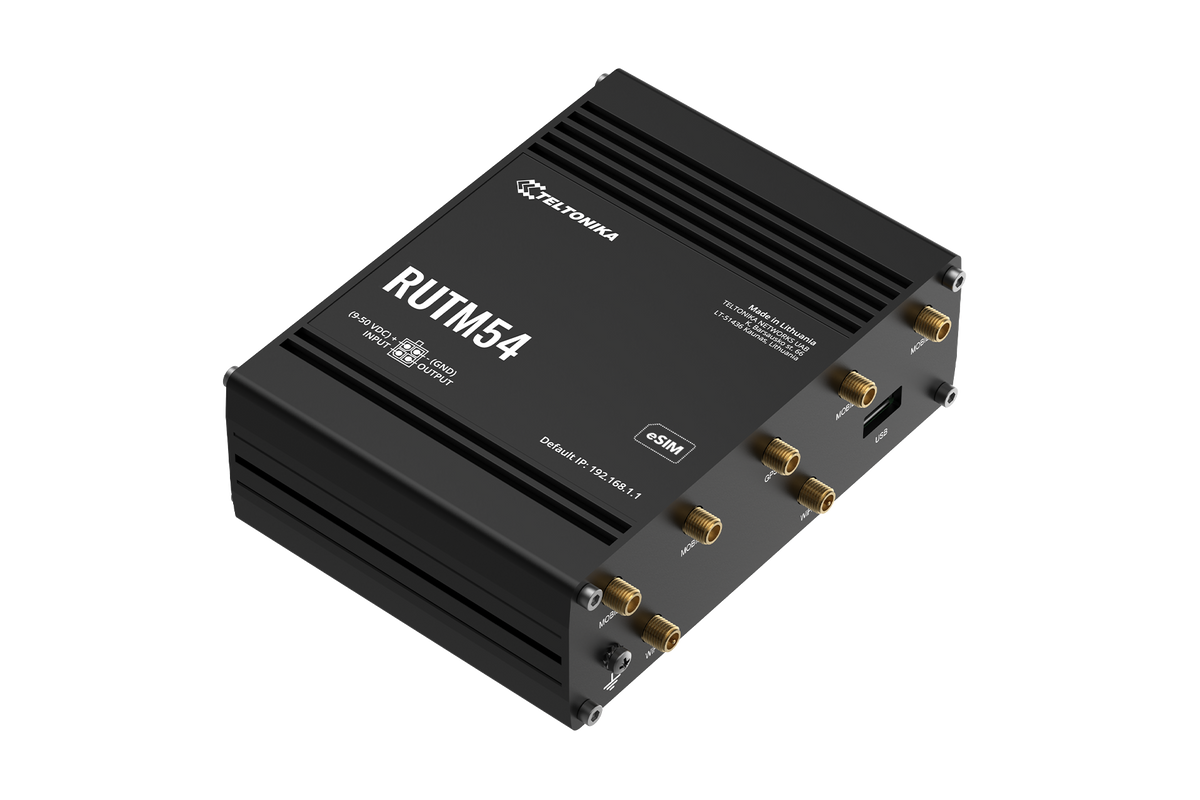
- Dual-band Wi-Fi, GNSS, USB, and I/O: 2.4 GHz / 5 GHz Wi-Fi, GNSS for location, a USB Type-A port, and one digital input and output.
- Wide temperature rating: -40°C to +75°C operation for hot cabinets and outdoor enclosures.
Technical Specifications
| Specification | Detail |
|---|---|
| Brand / model | Teltonika RUTM54 |
| Order code / SKU | RUTM54000000 |
| Cellular | 5G SA and NSA with a US-made Telit modem; 4G and 3G fallback |
| Max RF power | 24 dBm WCDMA, 24 dBm LTE, 27 dBm LTE B41 (HPUE), 24 dBm 5G, 27 dBm 5G n41/n77/n78 (HPUE), 20 dBm Wi-Fi 2.4 GHz, 23 dBm Wi-Fi 5 GHz |
| SIM | 2 x SIM slots plus eSIM |
| Ethernet | 5 x Gigabit Ethernet (RJ45) |
| Wi-Fi | Dual-band 2.4 GHz / 5 GHz |
| GNSS | Yes |
| USB | 1 x USB Type-A |
| I/O | 1 x digital input, 1 x digital output (on the 4-pin power connector) |
| Management | HTTPS WebUI, SSH, SMS utilities (active SIM required), Teltonika RMS |
| LED indicators | Power, 3G/4G/5G, signal strength, Ethernet, WAN source (SIM1/SIM2/Wi-Fi/ETH), Wi-Fi 2.4/5 GHz |
| Power adapter rating (when included) | 18 W; 100-240 VAC input; 12 VDC, 1.5 A output; 4-pin plug |
| Average power draw | About 3.1 W idle (no SIM); 3.6-3.8 W idle with mobile data on; 11.6-11.9 W with heavy 5G, Wi-Fi, five LAN devices, GNSS, and a USB device |
| Housing dimensions | 132 x 44.2 x 95 mm (without antenna connectors and screws) |
| Weight | 530 g |
| Operating temperature | -40°C to +75°C |
| Operating humidity | 10% to 90% (non-condensing) |
| HS / HTS code | 851762 / 8517.62.00 |
What's in the Box
The standard RUTM54 package includes the router, an US PSU with 4-pin connector 18 W, 4 x swivel mobile antennas (SMA male), 2 x magnetic-mount Wi-Fi antennas (RP-SMA male, 1.5 m cable), 1 x adhesive GNSS antenna (SMA male, 3 m cable), a 1.5 m Ethernet cable, a SIM adapter kit, and a Quick Start Guide.
Best For, Use Cases and Setup Tips
Best for: data-intensive sites such as video surveillance uploads, digital signage networks, and branch offices; organizations that prefer a US-made modem; and multi-site rollouts that benefit from eSIM carrier switching.
Not ideal for: very compact installs (see the RUTM20), jobs that need serial ports, or simple backup links where a 4G router is enough.
- Antenna placement: Attach all four mobile antennas, check Status → Network for signal strength, and adjust placement. Mount the GNSS antenna with a clear view of the sky.
- First login: Browse to 192.168.1.1, sign in as admin with the password on the device label, and set a new password (8+ characters with an uppercase letter, a lowercase letter, and a digit).
- Alternate power: If you power the router from a source other than the supplied adapter, the DC supply or passive PoE source must be classified as PS2.
- Power planning: Average draw reaches about 12 W under heavy load, so size DC or battery supplies with headroom.
- Harsh sites: Use dielectric grease on SIM contacts in high-vibration spots and industrial-grade SIMs in extreme temperatures or humid air.
Comparison at a Glance
| Model | Ethernet | SIM | Extras | Operating temp. |
|---|---|---|---|---|
| RUTM54 | 5 x Gigabit | Dual SIM + eSIM | US-made Telit modem, HPUE, GNSS, USB | -40°C to +75°C |
| RUTM50 | 5 x Gigabit | Dual SIM | North America version, GNSS, USB, Modbus/MQTT/OPC UA | -40°C to +40°C |
| RUTM20 | 2 x RJ45 | Dual SIM + eSIM | Global Telit modem, active PoE in/out, compact | -40°C to +40°C |
FAQ
Does the RUTM54 include eSIM?
Yes. It has two physical SIM slots plus eSIM, with auto-failover and backup WAN switching.
What is HPUE and why does it matter?
High Power User Equipment raises maximum transmit power to 27 dBm on LTE B41 and 5G n41, n77, and n78. Higher uplink power helps sites at the edge of coverage send data more reliably.
Does it come with a U.S. power supply?
Yes, US PSU with 4-pin connector 18 W
How many Ethernet ports does it have?
Five Gigabit Ethernet ports.
What temperatures can it handle?
-40°C to +75°C, with 10% to 90% humidity (non-condensing).