


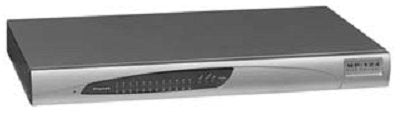

Description
The AudioCodes MediaPack 124 DC-powered variant brings the same 24-port FXS analog gateway capabilities as the AC model to environments built on DC power infrastructure — carrier facilities, central offices, and any site using -48V DC distribution. All 24 FXS ports connect analog devices to your SIP network with T.38 fax relay, G.729A voice compression, and zero-touch provisioning. The DC power supply eliminates the need for an AC-to-DC converter and integrates cleanly into telecom-standard power plants.
The Telecom Spot Take
Telecom facilities and carrier-grade environments standardize on DC power (-48V) for a good reason: DC power plants provide cleaner, more reliable power with battery backup already built into the distribution infrastructure. The MP124/24S/DC/SIP is specified precisely for those environments — same 24-port FXS platform as the AC version, with a DC-compatible internal power supply in place of the standard AC unit. This means no external DC-to-AC inverter cluttering your rack, no efficiency loss from unnecessary power conversion, and clean integration with your existing power monitoring systems. Telcos integrating analog subscriber lines into VoIP infrastructure, or enterprises with DC power in their server rooms, should spec this variant from the start.
Key Features
- 24 FXS ports (loop-start): Connects 24 analog devices — phones, fax machines, emergency lines, or PBX station ports — to SIP in a single compact unit.
- DC-powered: Internal DC power supply integrates directly with -48V DC power plants in carrier facilities and telecom environments — no AC-to-DC converter required.
- T.38 fax relay: Group 3 fax relay up to 14.4 kbps with per-port automatic voice/fax mode switching across all 24 lines.
- G.711, G.723.1, G.726, G.727, G.729AB codecs: Full codec suite for maximum flexibility between voice quality and WAN bandwidth optimization.
- SIP RFC 3261 signaling: Full SIP compatibility with all major hosted and on-premises VoIP platforms; H.323 and MGCP also supported.
- G.168-2004 echo cancellation (128 ms): Consistent toll-quality voice on every port regardless of analog loop length or characteristics.
- Zero-touch provisioning: TFTP/HTTP-based auto-provisioning for mass deployment without per-site configuration overhead.
- Stand Alone Survivability (SAS): Local call continuity maintained during WAN or SIP server failures.
- SNMP and web management: Full enterprise and carrier-grade network management integration.
Technical Specifications
| Specification | Detail |
|---|---|
| Part Number | MP124/24S/DC/SIP |
| FXS Ports | 24 × FXS (loop-start) |
| Network Interface | 1 × 10/100Base-T Ethernet |
| Signaling Protocols | SIP (RFC 3261), H.323 v4, MGCP (RFC 3435) |
| Voice Codecs | G.711 (A-law, μ-law), G.723.1, G.726, G.727, G.729A/AB |
| Fax | T.38 (Group 3, up to 14.4 kbps), T.30 passthrough |
| DTMF | RFC 2833, SIP INFO, In-band |
| Echo Cancellation | G.168-2004, up to 128 ms tail length |
| Voice Quality | VAD, CNG, Dynamic Jitter Buffer |
| QoS | IEEE 802.1p/Q VLAN, DiffServ/TOS, RTCP-XR |
| Management | Web GUI, TFTP, HTTP/HTTPS, SNMP, Zero-touch provisioning |
| Power | Internal DC power supply (-48V DC) |
| Rack Mount | 19-inch rack-mountable (rack kit sold separately: MP124RMK) |
| Certifications | FCC, CE |
| Vendor | AudioCodes |
Frequently Asked Questions
- What voltage does the DC version of the MP124 require?
- The MP124/24S/DC/SIP is designed for -48V DC power, the standard voltage used in telecom and carrier facilities. It integrates directly with DC power plants without requiring a separate AC-to-DC converter.
- Is the DC variant functionally identical to the AC version?
- Yes — same 24 FXS ports, same codec support (G.711 through G.729AB), same SIP/H.323/MGCP signaling, same zero-touch provisioning, same T.38 fax relay. The only difference is the internal power supply: DC instead of AC. Choose this variant if your site runs DC power distribution.
- Can I mount the MP124 DC in a 19-inch rack?
- Yes. The MP124 is rack-mountable with the optional MP124RMK rack mount kit (sold separately). The DC variant uses the same rack mounting hardware as the AC version.