




Description
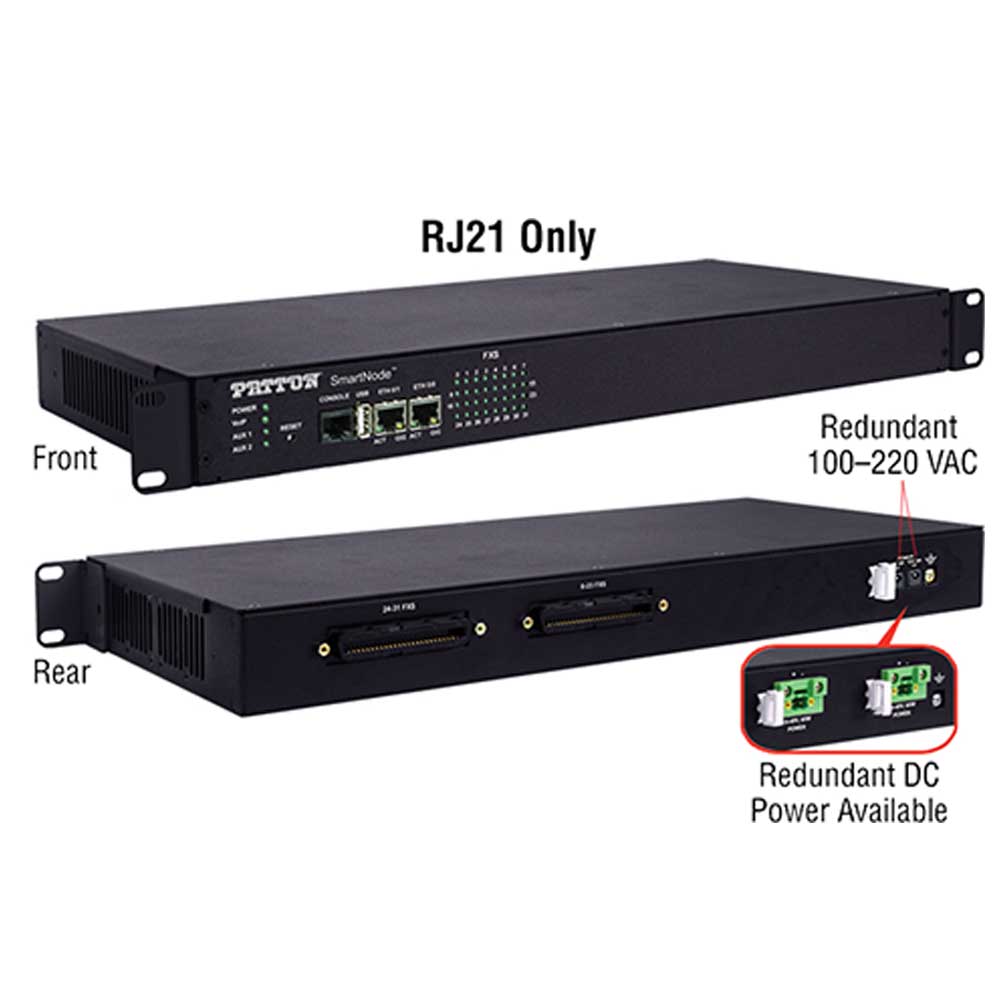
Many organizations still depend on analog PSTN trunk lines but want to connect them cleanly and efficiently to modern SIP-based phone systems or unified communications platforms. The Patton SN4741A SmartNode VoIP Gateway with RJ21 connector solves this by delivering 16 FXO ports through a single 50-pin RJ21 (Amphenol) interface. This design consolidates all trunk connections into one cable, dramatically simplifying rack cable management and installation in professional environments. The gateway supports 16 simultaneous VoIP calls from day one and offers a straightforward upgrade path to full eSBC capabilities with up to 200 SIP sessions. Dual Gigabit Ethernet ports ensure reliable, high-quality voice transport, while external AC power with optional redundancy supports business-critical uptime. Whether you are maintaining existing PSTN numbers, adding local breakout alongside SIP trunks, or managing a hybrid environment, the RJ21 variant provides a neat, scalable, and enterprise-ready solution for facilities that value organized cabling.
The Telecom Spot Take
Our customers who manage larger multi-line installations, telco closets, or enterprise racks often prefer the RJ21 connector version because it replaces 16 individual cables with one consolidated multi-pair cable. This reduces clutter, improves airflow, and speeds up installation and troubleshooting in dense environments. Like the rest of the SN4740 series, the SN4741A starts with 16 FXO ports and 16 VoIP calls but can be upgraded later to eSBC mode for significantly higher SIP capacity and advanced security features—protecting your hardware investment as needs grow. Patton’s focus on reliable analog signaling and interoperability makes this gateway a practical choice for IT directors and facilities managers who need dependable PSTN-to-SIP connectivity without sacrificing rack organization or future flexibility.
Key Features
- 16 FXO ports via single RJ21 50-pin connector — Consolidates all analog PSTN trunk connections into one cable for cleaner rack management, reduced cable clutter, and faster installation in professional telco or enterprise environments.
- 16 concurrent VoIP calls out of the box — Reliably handles moderate inbound and outbound call volumes across departments or sites.
- Upgradeable to eSBC functionality (up to 200 SIP calls) — Future-proof your deployment by adding advanced session border controller features, higher capacity, and survivability without replacing the gateway.
- Dual Gigabit Ethernet ports — Provide robust, high-bandwidth network connectivity with support for QoS and flexible deployment options.
- Optional SIP-TLS/SRTP security and transcoding (max 8 calls) — Enable encrypted signaling and media plus codec conversion resources when compliance or interoperability requirements arise.
- Flexible power with optional redundancy — External 100–240 VAC power supply with the option to add a redundant supply for enhanced uptime in critical installations.
- Multiple management options — Configure and monitor easily through the web interface, console port, or USB for file transfers and backups.
Technical Specifications
Analog Interfaces
- 16 × FXO ports via 1 × RJ21 (50-pin Amphenol/Telco) connector
- 2-wire Loop Start signaling with programmable impedance
- Ring detection, tone detection, Caller ID reception, disconnect supervision
VoIP & Call Capacity
- Base: 16 simultaneous VoIP calls
- Upgradeable to eSBC: up to 200 SIP calls
- Optional transcoding: maximum 8 calls
- T.38 fax relay support
Network Interfaces
- 2 × 10/100/1000 Mbps Gigabit Ethernet ports
- Auto-sensing with routing and QoS capabilities typical of the platform
Management & Provisioning
- 1 × Console port
- 1 × USB port (configuration and file transfer)
- Web GUI and CLI access
Power & Physical
- Single External Universal Input (EUI) power supply: 100–240 VAC
- Optional redundant power supply available
- Compact rack-mountable form factor (1U-class for 16–32 port configurations in the series)
Environmental
Designed for enterprise and commercial environments (standard operating temperature and humidity ranges apply).
Comparison at a Glance
- Vs. Patton SN4741A RJ11 version (same model, individual RJ11 ports): The RJ21 variant uses a single 50-pin connector instead of 16 separate cables, delivering significantly cleaner rack cable management and faster installation in dense or professional cabling environments. The RJ11 version offers easier per-port access for frequent changes or troubleshooting.
- Vs. smaller Patton SmartNode 4140 series (up to 8 FXO ports): This 16-port RJ21 model doubles capacity while adding consolidated cabling and a clear upgrade path to 200 SIP sessions and eSBC features that entry-level gateways typically lack.
FAQ
What is the main advantage of the RJ21 connector on this model?
It consolidates all 16 FXO ports into one 50-pin cable, reducing cable clutter, improving rack organization, and simplifying installation in telco closets or enterprise environments that use multi-pair cabling standards.
What is the primary job of the Patton SN4741A gateway?
It connects analog PSTN trunk lines from your telephone provider to SIP-based phone systems or UC platforms so you can keep using existing numbers and lines while gaining modern calling features.
Can I use this with 3CX, Asterisk, or other SIP PBXs?
Yes. The SN4741A is built as a standards-based SIP gateway and integrates with popular SIP-compatible systems and hosted UC solutions.
What does “upgradeable to eSBC” actually give me?
It unlocks significantly higher SIP session capacity (up to 200 calls), plus advanced session border controller functions such as enhanced security, topology hiding, and automatic survivability for continued local calling if the primary network connection drops.
Is redundant power supported?
Yes. The unit ships with a single external AC power supply and accepts an optional redundant power supply for higher uptime requirements.
How do I configure and manage the gateway?
Use the built-in web interface for everyday tasks, the console port for CLI access, or the USB port to transfer configuration files and updates.
Does it handle fax calls?
Yes. T.38 fax relay is supported alongside voice calls for reliable document transmission over IP networks.