


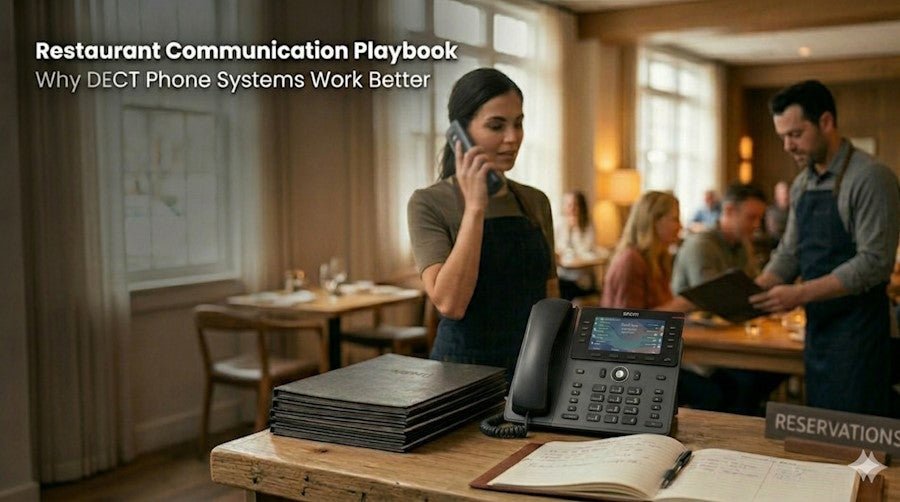
The Restaurant Communication Playbook: Is a Wireless DECT System the Missing Link?
Restaurant teams are in constant motion. Between the host stand managing a long wait, servers checking on the kitchen, and managers handling deliveries, communication can get messy fast. When it breaks down, service slows, orders get missed, and guests feel it.
While many "modern" solutions rely on apps and mobile devices, they often create more distractions than they solve. For small to mid-sized restaurants and growing chains, a dedicated wireless phone system is often the simpler and more reliable option.
In many cases, that means using a wireless DECT phone system built specifically for voice communication.
Why voice still matters in restaurants
Even with online ordering and reservation platforms, phone calls are still a big part of daily operations. Customers call to place takeout orders, check wait times, ask about allergies, or confirm reservations.
According to Snom’s restaurant use case data, 52% of customers still prefer to call in their orders. If your staff is missing calls or tied to a single desk phone, that can directly impact revenue and customer experience.
The "chain" challenge: If you run multiple locations, consistency matters. Staff should be able to move between stores without relearning how communication works each time.
Common communication pain points
- The "dead zone": Thick kitchen walls, walk-in coolers, or patios where signals drop off.
- Background noise: Busy kitchens and dining rooms making calls hard to hear.
- Durability issues: Phones exposed to drops, spills, and constant handling.
- Complicated call handling: Transferring or picking up calls shouldn’t slow staff down during a rush.
Why DECT works better than WiFi phones in restaurants

Unlike WiFi-based phones, DECT systems use a dedicated wireless signal between the base station and handsets. This helps reduce interference and keeps call quality more stable, even in environments with heavy network traffic.
For restaurants, that usually means fewer dropped calls, more consistent coverage, and less time troubleshooting connectivity issues.
Spotlight solution: the Snom M500 DECT system
We often point installers and SMB owners toward the Snom M500 system because it sits in that sweet spot between basic cordless phones and more complex enterprise setups.
A practical restaurant setup
For a typical restaurant layout, a mix of devices works best:
- Host stand: Snom M58 wireless desk phone for a clean, central call handling point.
- Dining floor / managers: Snom M55 handsets for mobility around the restaurant.
- Kitchen & patio: Snom M56 rugged handsets, built for tougher environments.
Key features that matter in real use

- Key System Emulation (shared line functionality): Staff can see active and held calls across devices and pick them up easily.
- IP67-rated rugged handset option: Protection against dust and water, making it suitable for kitchens, patios, and back-of-house areas.
- Antibacterial casing: Helps reduce germ spread in shared-use environments.
- Expandable coverage: Supports dual-cell setup to extend coverage across larger layouts.
Predictable pricing and support
Restaurants usually operate on tight margins, so cost and reliability matter. The Snom M500 system is typically priced competitively for small to mid-sized deployments and does not require complex infrastructure to get started.
Unlike many app-based systems, there are no per-user licensing fees tied to the handsets themselves, which helps keep ongoing costs more predictable. This can be especially helpful for restaurants that want a simple setup without adding recurring per-user app costs on top of their phone service.
Snom also backs the system with a 3-year advanced replacement warranty, which helps minimize downtime if a device needs to be replaced.
For larger rollouts or multi-location deployments, project pricing may also be available depending on the setup.
What about wireless headsets?
Wireless headsets can be useful in certain restaurant environments, especially for drive-thru operations or roles that require hands-free communication.
For most dine-in restaurants, however, cordless DECT phones are still the more practical option for handling incoming calls, placing callers on hold, and coordinating between staff.
In many cases, headsets work best as a complement to a phone system rather than a replacement.
How does it compare?
If you're weighing different options, here’s a quick look at how some of the common DECT systems stack up in real-world use.
While we focus on the Snom M500 for its fit in restaurant environments, it’s not the only option. If you're already using Yealink in your front office, their W-series can be a natural extension. And for smaller cafés or lower call volume setups, budget-friendly options like Grandstream can get the job done without overcomplicating things.
| System | Best For... | Key Advantage |
|---|---|---|
| Snom M500 | Busy restaurants & small chains | Shared line visibility, rugged handset options, simple deployment |
| Yealink W-Series | Offices & mixed-use environments | Strong fit for Teams or Yealink-based ecosystems |
| Grandstream DP series | Budget-conscious deployments | Affordable entry point for basic needs |
| Fanvil DECT | Newer or design-focused setups | Competitive pricing with a growing feature set |
| Poly DECT | Enterprise or legacy environments | Common in established UC deployments |
You can also explore more options in our cordless phone collection.
Need help figuring out the right setup?
Not sure what makes the most sense for your restaurant? We can help you sort through options based on your layout, staff size, and call volume.
Call us: 866-369-3394
Email us: sales@thetelecomspot.com