


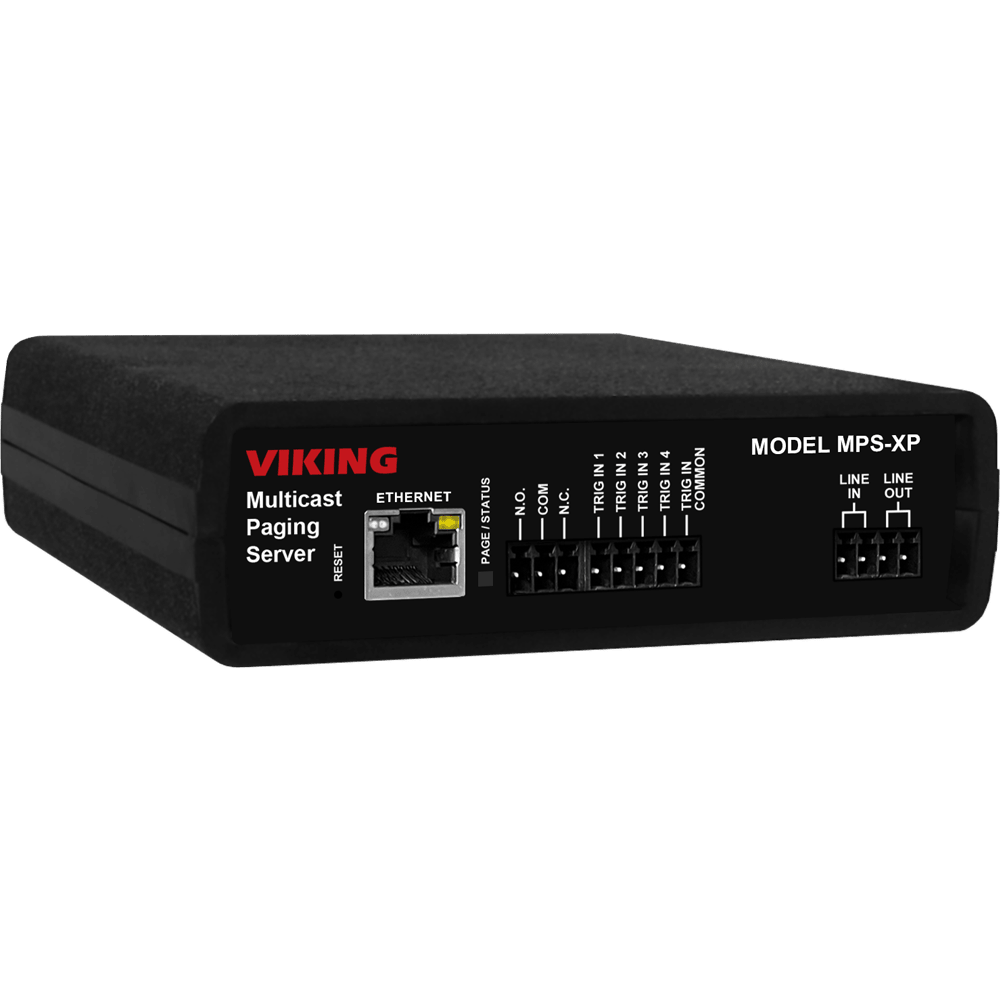


Description
Schools, plants, and campuses do not page one hallway. They page a wing, a building, or the whole site — and they need bells, lockdowns, and all-clear messages to fire on time. The Viking Electronics MPS-XP Multicast Paging Server is a PoE SIP paging endpoint that supports up to 100 independently configurable multicast zones and up to 100 SIP accounts with independent registration. Call one extension to page everywhere, give each zone its own extension, or fire a stored file from a dry-contact trigger. A secure web interface runs the calendar, rules, and integrations.
The Telecom Spot Take
This box is the brain of a multizone SIP paging system, not a hallway speaker. Viking built it for sites that already have (or will add) multicast speakers, IP horns, and analog amps that need a 600-ohm line feed and a relay closure. Our customers who run schools, universities, and manufacturing floors get the most from the 100-zone map, the bell scheduler with exception dates, and store-and-forward pages that you can review before they hit the speakers.
Key Features
- Up to 100 SIP accounts, each with its own registration. Map one extension to “all call,” or give every building its own number on the same box.
- Up to 100 multicast zones with volume, zone priority, and QoS. Route live pages by DTMF code or by which SIP account rang in.
- Store-and-forward paging. Record the page, review it, then release it so live mics do not feed back through nearby speakers.
- 2.5 GB of onboard audio. More than 21 hours of bells, tones, and announcements in WAV, MP3, OGG, or FLAC.
- Calendar and bell scheduler. Recurring patterns, time-triggered events, exception calendars, delays, and skipped-event support for holidays and late starts.
- Four trigger inputs. Configurable debounce and polarity for evacuation, lockdown, weather, and all-clear contacts.
- One programmable relay (2 A @ 30 VDC / 250 VAC max). Timed pulses, flash patterns, or rule-based closures to kick an analog amp, strobe, or door circuit.
- 600-ohm line in and line out. Feed background music or a radio URL in; send mono paging audio out to a legacy amplifier.
- Rules engine: 100 rules. Events, conditions, and actions without writing code.
- REST API, MQTT with TLS, and HTTP webhooks. Tie paging to IoT, building management, or any system that can hit a URL.
- PoE Class 1, under 4 watts. One Cat5 (or better) drop carries power and data. IEEE 802.3af, SIP 2.0 RFC3261, 100BASE-TX with auto-crossover.
- Designed, manufactured, and supported in the USA. Two-year limited warranty
Technical Specifications
| Item | Specification |
|---|---|
| Model / SKU | MPS-XP |
| Product type | PoE SIP multicast paging server |
| SIP accounts | Up to 100, independent registration |
| Multicast zones | Up to 100, with volume, priority, and QoS |
| Audio storage | 2.5 GB; over 21 hours (WAV, MP3, OGG, FLAC) |
| Rules engine | 100 rules (events, conditions, actions) |
| Trigger inputs | 4, configurable debounce and polarity |
| Relay output | 1 programmable; 2 A @ 30 VDC / 250 VAC maximum |
| Line I/O | 600-ohm line-level input; 600-ohm line-level output (mono) |
| Power | PoE Class 1 (< 4 watts), IEEE 802.3af |
| Network | 10/100BASE-TX, auto-crossover; SIP 2.0 RFC3261 |
| SIP transports | UDP, TCP, TLS |
| SIP audio codecs | Opus, Speex 32K/16K/8K, G.711u, G.711a, G.722, GSM, iLBC, or L16 |
| Multicast audio codecs | G.722, G.711a, G.711u, Opus, Speex 32K |
| Connections | (1) RJ45 10/100; (1) 3-position terminal block; (1) 4-position terminal block; (1) 5-position terminal block |
| Dimensions | 5" × 5.25" × 1.5" (127 × 133 × 38 mm) |
| Shipping weight | TBD (manufacturer) |
| Operating temperature | 0°F to 140°F (−17°C to 60°C) |
| Humidity | 5% to 95% non-condensing |
| Programming | Viking Device Manager + secure web UI; Windows 10/11, Linux, or Mac on the same LAN |
| Default web login | admin / admin (change on first login) |
| Ethernet run | 100 m (328 ft) typical; PoE extender or fiber media converter for longer runs |
| Switch-port notes | Not trunk mode; 100 Mbps full duplex; disable STP or enable Portfast |
| Origin / warranty | Designed, manufactured, and supported in the USA; 2-year limited warranty |
Install note from Viking: installation requires a network administrator / IT technician.
Comparison at a Glance
Same-family Viking options, using only Viking-published data. The MPS-XP does not include a speaker amplifier. Pair its 600-ohm line out and relay with an amp or with IP multicast endpoints.
| Viking MPS-XP | Viking PA-IP | Viking PA-250-IP | |
|---|---|---|---|
| Role | Multicast paging server | SIP/multicast adapter with built-in amp | 250-watt 70V SIP/multicast paging amplifier |
| SIP accounts | Up to 100, independent registration | SIP endpoint (adapter) | SIP/multicast amplifier |
| Multicast zones / groups | Up to 100 independent zones | Up to 10 multicast paging groups | SIP/multicast paging amplifier |
| Onboard amp | No (600-ohm line out to an external amp) | Built-in high-efficiency Class D amp (6 W class in Viking’s PA-IP manual) | 250 watts, 70V |
| Audio library / scheduler | 2.5 GB storage, calendar + bell scheduler, 100-rule engine | Line-level BGM in; pre-page tone; multicast receive | Paging amplifier for loud coverage |
| Integrations | REST API, MQTT (TLS), HTTP webhooks | SIP/multicast paging adapter feature set | SIP/multicast amplifier feature set |
| Power | PoE Class 1 (< 4 W) | PoE Class 3 (< 13 W) | SIP/multicast 250 W amplifier |
| Best fit from Viking’s own use cases | Schools, universities, manufacturing; multizone + scheduled + triggered pages | VoIP-to-analog or small multicast speaker runs | Loud 70V analog speaker plants that also need SIP/multicast |
FAQ
Who is the MPS-XP for?
Viking calls out schools, universities, and manufacturing facilities — any site that needs flexible multizone paging, event-triggered announcements, or automated message scheduling.
Does it replace my paging amplifier?
No. It is a SIP paging endpoint and multicast server. Use the 600-ohm line output and the relay to drive a legacy analog amplifier, and/or send multicast to IP speakers and horns.
How do staff pick a zone?
Three manufacturer modes: one SIP account to one zone; DTMF codes on a live SIP call to pick zones; or a dedicated SIP account per zone. You can also play stored files from SIP or from the four dry-contact triggers.
Can it run class-change bells without a live phone call?
Yes. The built-in calendar scheduler and bell scheduler play prerecorded files on recurring patterns, with exception dates, delays, and skipped events. No SIP account is required for that mode.
What do I need on the network?
A PoE Class 1 port (IEEE 802.3af), 100 Mbps full duplex, not in trunk mode, STP off or Portfast on. Discover the unit with Viking Device Manager on the same LAN, then finish setup in the web UI. Default login is admin / admin; change it before you go live.
How does it talk to other building systems?
Viking documents a full REST API, MQTT publish/subscribe with TLS, and HTTP webhooks so another system can start a page with a URL. The 100-rule engine ties those events to zones, files, and the relay.