


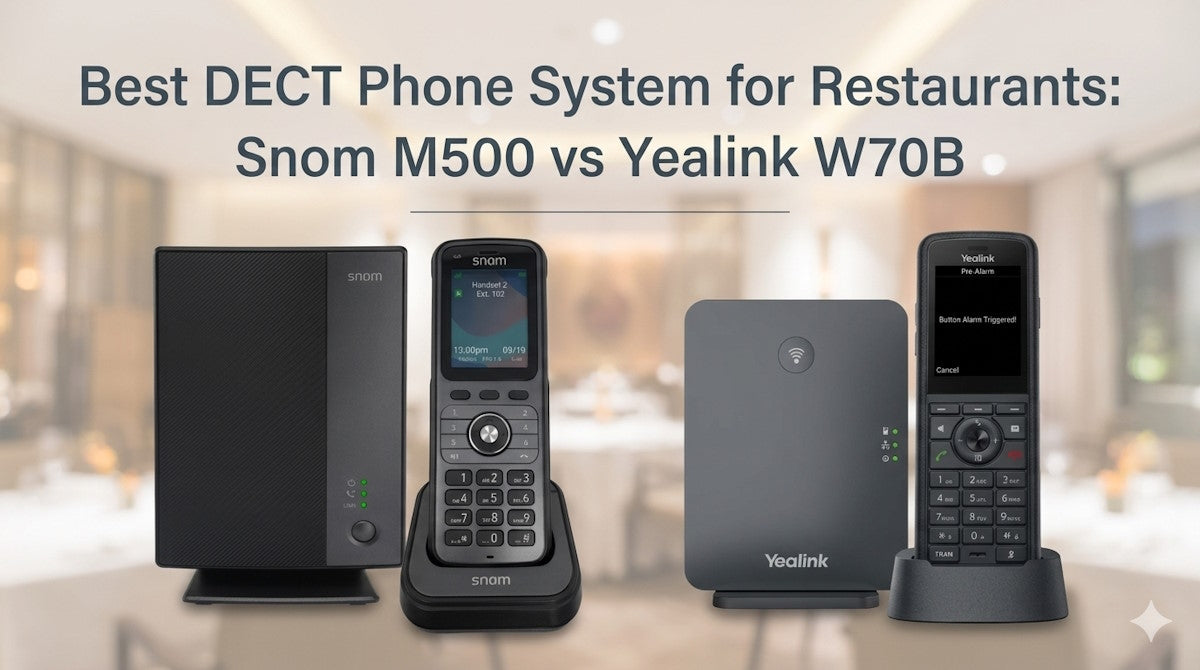
Best DECT Phone System for Restaurants: Snom M500 vs Yealink W70B
TL;DR: Choose Snom M500 if your team relies on Shared Call Emulation and traditional shared-line workflows. Choose Yealink W70B if you need higher single-base call capacity, up to 20 simultaneous calls, and a system designed for straightforward deployment.
In a busy restaurant, the phone isn’t just another device. It’s the control center for reservations, takeout, and internal coordination. Generic office phone systems can struggle in these high-demand environments where noise, constant movement, and shared staff devices are part of everyday operations.
If you’re still comparing general restaurant phone options, our Restaurant Communication Playbook: Are Wireless DECT Phone Systems the Missing Link? explains why DECT systems are often a better fit than WiFi or standard desk phone setups.
Why Restaurants Still Choose DECT Over WiFi
- Avoids WiFi Congestion: DECT operates on dedicated spectrum separate from your restaurant’s WiFi network, so guest traffic, POS tablets, and other WiFi devices aren’t competing with your phones for the same wireless network.
- Purpose-Built Voice Coverage: DECT systems are designed for reliable cordless voice coverage across a business. Actual range depends on the building layout, walls, and equipment.
- Long Battery Life: Current business DECT handsets can provide 12 hours or more of talk time depending on the handset and usage, making them practical for long shifts.
Snom M500 vs Yealink W70B at a Glance
| Feature | Snom M500 Ecosystem | Yealink W70B Ecosystem |
|---|---|---|
| Registered Devices | Up to 10 in single-cell / up to 16 in dual-cell | Up to 10 DECT devices |
| Simultaneous Calls | Up to 8 narrowband or 4 wideband per base; up to 16 narrowband or 8 wideband in dual-cell | Up to 20 simultaneous calls on one base |
| Base Type | Single-cell or dual-cell | Single-base |
| Key Advantage | Shared Call Emulation for traditional shared-line workflows | High single-base call capacity and straightforward provisioning |
| Rugged Handset | M56 | W59R Pro |
| Hygiene Options | M55, M56, and M58 feature antibacterial housing or plastic | W59R Pro uses antimicrobial materials and is designed to withstand regular disinfectant wiping |
| Desk-Style Phone | M58 | — |
| Best Fit | Restaurants that value shared-line workflows, cordless desk phones, or dual-cell coverage | Restaurants with high takeout, reservation, or multi-handset call volume |
The Snom M500 Series: Built Around Workflow
The Snom M500 system focuses on replicating traditional line-based workflows that restaurant teams may already be familiar with.
The Snom Advantage: Shared Call Emulation (SCE)
Snom’s Shared Call Emulation allows multiple handsets to monitor and access shared lines. Staff can see line activity through programmable LED keys, making it easier for one employee to place a call on hold and another employee to retrieve it from a different phone.

Deployment note: Snom’s Shared Call Emulation is handled within the M500 system, allowing shared line-style behavior without requiring a traditional key system. As with any SIP deployment, available features and provisioning can still vary by VoIP service or PBX platform.
Snom Hardware Breakdown
- The Base (M500 Base Station): Supports up to 8 narrowband or 4 wideband simultaneous calls per base, with dual-cell expansion available.
- The Host Stand (M58 Desk Phone): A cordless DECT desk phone that provides a traditional desktop form factor without requiring Ethernet cabling at the host stand.
- The Floor (M55 Handset): Features 6 programmable LED keys for shared-line and frequently used functions, plus up to 19 hours of narrowband talk time or 12 hours of wideband talk time for long shifts.
- The Kitchen (M56 Rugged): IP67-rated with a large, tactile keypad designed to remain practical in demanding work environments.
- Room to Grow: Two M500 bases can be paired in a dual-cell configuration for up to 16 registered phones while expanding coverage and overall system capacity across larger restaurant layouts.
The Yealink W70B Ecosystem: Built for Call Capacity and Easy Deployment
The Yealink W70B ecosystem is a high-capacity single-base DECT platform designed for straightforward deployment and compatibility with a broad range of Yealink cordless handsets.
The Yealink Advantage: High Call Capacity
The W70B base supports up to 20 simultaneous calls on a single base station, significantly higher than a single Snom M500 base. This can make it especially attractive for restaurants with high takeout, reservation, or catering call volume.

Deployment note: Both Snom and Yealink systems are SIP-based. The W70B supports Yealink RPS, plug-and-play provisioning, and several standard auto-provisioning methods, making it straightforward to deploy and manage across multiple handsets.
Yealink Hardware Breakdown
- The Base (W70B Base Station): Supports up to 10 handsets, 10 SIP accounts, and up to 20 simultaneous calls.
- Front-of-House (W73H / W78H): Modern cordless handsets with color displays. The W78H adds Bluetooth 5.1 for wireless headsets and a vibration alarm that can be useful in noisy environments.
- Back-of-House (W59R Pro Rugged): IP67-rated, drop-resistant, and made with antimicrobial materials designed to tolerate regular disinfectant wiping. It also adds Bluetooth 5.2 and safety features for more demanding work environments.
- Flexible Noise Reduction (FNR): Helps reduce background noise so staff can communicate more clearly even in busy restaurant environments.
For complete starter kits, options like the Yealink W73P DECT IP Phone System or Yealink W79P Ruggedized DECT IP Phone System bundle the base and handset together for faster deployment.
Which Setup Style Fits Your Restaurant?
Snom M500 + M58 Desk Phone + M55 Handset.
A good fit for a clean host-stand setup and staff who want shared-line visibility and a familiar call-handling workflow.
Yealink W70B + 6 Handsets (W73H/W78H).
Designed for higher call volume and managers who may benefit from Bluetooth headset support while moving around the restaurant.
Either System + Rugged Handsets (M56 or W59R Pro).
A practical choice when phones may be dropped, splashed, disinfected frequently, or shared in back-of-house areas.
The Verdict
If your team relies on "Line 1 / Line 2" style workflows and wants a phone system that behaves more like a traditional shared-line setup, the Snom M500 is the specialist. Its dual-cell design also gives restaurants a path to expand coverage and support additional phones as their needs grow.
If your priority is handling higher call volume from a single DECT base with straightforward provisioning and a broad selection of compatible handsets, the Yealink W70B is the high-capacity choice. It is particularly well suited to busy takeout, reservation, catering, and multi-handset environments.